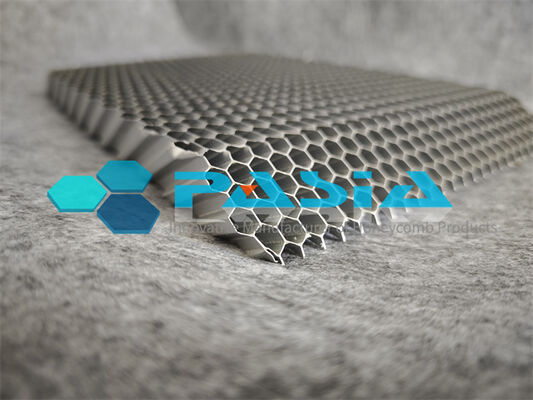
Innovative Manufacturer of Honeycomb and MI Heating Products
Innovative Manufacturer of Honeycomb and MI Heating Products
Product Details:
Payment & Shipping Terms:
|
| Material: | Al3003, Al5052 | Bonding Method: | Glue Bonded |
|---|---|---|---|
| Cell Size: | Less Than 3 Mm At Cell Side Length | Foil Thickness: | Up To 0.15 Mm |
| Foil Treated: | Hexavalent Chromium Treated | Application: | Shipbuilding, Train Etc |
| Optimized Supply: | Expanded | Supply Method: | Expanded, Slice, Block |
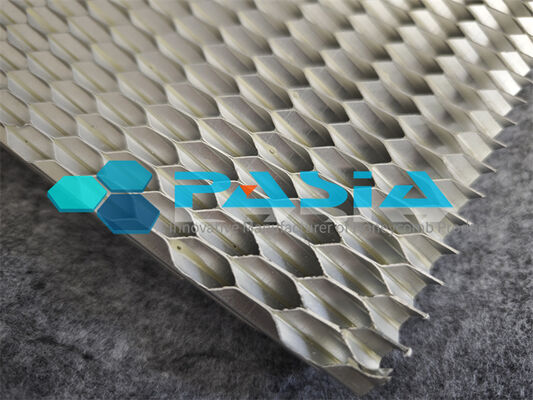
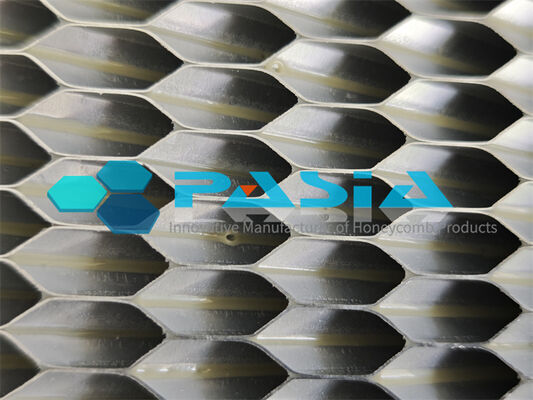
Trivalent Chromium Passivated Aluminum Honeycomb Core: Aerospace-Grade Corrosion Resistance, RoHS-Compliant Lightweight Structural Performance, and High-Bond-Strength Reliability
Untreated aluminum honeycomb core has a structural liability that design engineers cannot ignore: in high-humidity, coastal, or aerospace environments where salt spray is a constant threat, unprotected aluminum foil degrades from the inside out. The natural oxide film on bare aluminum is weak and unstable, offering poor adhesion to structural adhesives and leaving the core vulnerable to delamination, pitting, and premature loss of load-bearing capacity. Traditional hexavalent chromium conversion coatings solved much of this problem—but they introduced a regulatory and environmental burden that forward-thinking procurement teams and aerospace OEMs can no longer absorb.
The trivalent chromium passivated aluminum honeycomb core resolves that tension. It delivers corrosion protection that meets or exceeds military and aerospace specifications, while eliminating hexavalent chromium from the supply chain.
A Conversion Coating—Not a Superficial Layer
The core is manufactured from high-grade aluminum alloy foil (3003H19 or 5052H18), bonded with modified epoxy adhesive, and subjected to a specialized trivalent chromium conversion coating process. Unlike a paint or a topcoat, this is a molecular-level chemical conversion: the trivalent chromium bath reacts with the aluminum surface to form a complex amorphous passive film—primarily CrOOH·nH₂O—that becomes an integral part of the metal. The film is uniform, colorless to light green, and typically less than 0.25 microns thick, adding essentially no dimensional change to the foil.
That conversion layer does two jobs simultaneously. First, it passivates the aluminum surface, dramatically slowing the electrochemical reactions that drive corrosion. Second, it creates a porous, high-surface-energy active interface that wets out structural adhesives far more effectively than bare aluminum.
Corrosion Performance Backed by Salt-Spray Data
The benchmark for aluminum honeycomb core corrosion resistance in aerospace supply chains is ASTM B-117 neutral salt spray, evaluated against AMS-C-7438. The allowable weight loss under AMS-C-7438 is 125 mg/ft² (1,345 mg/m²) after 30 days. Trivalent chromium passivated honeycomb cores have demonstrated typical weight loss of 15 mg/ft² (161.4 mg/m²) under the same conditions—roughly one-eighth of the specification limit. Independent electrochemical evaluations of trivalent chromium-treated aluminum surfaces have reported no visible corrosion for up to 200 hours in 5% salt spray, with post-treatment oxidation further extending protection.
This performance matters because honeycomb core corrosion is not a cosmetic issue. In bonded sandwich structures, the core is often the weak link: once corrosion initiates at the core–adhesive interface, bond durability degrades and structural integrity follows. A conversion coating applied to the foil before node adhesive bonding ensures protection over the full foil surface area, including the bonding interfaces that are inaccessible after assembly.
High-Bond-Strength Interface for Demanding Sandwich Structures
The trivalent chromium conversion film is specifically engineered for adhesion. Higher Cr(III) content in the film raises the surface free energy of the aluminum foil, improving adhesive wettability, spreading, and penetration. The result is an interface that forms both mechanical interlocking and chemical bonding with epoxy and phenolic structural adhesives.
Node bonding strength—the critical metric for honeycomb core integrity—typically requires >2.0 N/mm in aerospace-grade specifications. Trivalent-chromium-treated cores meet or exceed this threshold, reducing the risk of node failure and delamination under service loads. Dry adhesion performance also satisfies ASTM D3359, making the treated core an ideal substrate for organic coatings and paints where secondary finishing is required.
Critically, the treatment preserves the intrinsic mechanical efficiency of aluminum honeycomb. The core retains its high strength-to-weight and stiffness-to-weight ratios—among the highest of any structural core material—while gaining the durability needed for aggressive environments.
---

Specification of Aluminum Honeycomb Core:
| Item | Unit | Specification | ||||||||
| Cell Size | inch | 1/8” | 3/16” | 1/4” | ||||||
| mm | 2.6 | 3.18 | 3.46 | 4.33 | 4.76 | 5.2 | 6.35 | 6.9 | 8.66 | |
| Side Length | mm | 1.5 | 1.83 | 2 | 2.5 | 2.75 | 3 | 3.7 | 4 | 5 |
| Foil Thickness | mm | 0.03-.05 | 0.03-.05 | 0.03- 0.05 | 0.03-.06 | 0.03-0.06 | 0.03-0.08 | 0.03-0.08 | 0.03-0.08 | 0.03-.08 |
| Width | mm | ≤440 | ≤440 | ≤440 | ≤1800 | ≤1800 | ≤1800 | ≤1800 | ≤1800 | ≤1800 |
| Length | mm | ≤1500 | ≤1500 | ≤2000 | ≤3000 | ≤3000 | ≤3200 | ≤4000 | ≤4000 | ≤5500 |
| Height | mm | 1.7~150 | 1.7~150 | 1.7~150 | 3~150 | 3~150 | 3~150 | 3~150 | 3~150 | 3~150 |
|
|
||||||||||
| Item | Unit | Specification | ||||||||
| Cell Size | inch | 3/8” | 1/2” | 3/4” | 1” | |||||
| mm | 9.53 | 10.39 | 12.7 | 13.86 | 17.32 | 19.05 | 20.78 | 25.4 | ||
| Side Length | mm | 5.5 | 6 | 7.33 | 8 | 10 | 11 | 12 | 15 | |
| FoilThickness | mm | 0.03-.08 | 0.03-0.08 | 0.03-0.08 | 0.03-.08 | 0.03-0.08 | 0.03-0.08 | 0.03-0.08 | 0.03- 0.08 | |
| Width | mm | ≤1800 | ≤1800 | ≤1800 | ≤1800 | ≤1800 | ≤1800 | ≤1800 | ≤1800 | |
| Length | mm | ≤5700 | ≤6000 | ≤7500 | ≤8000 | ≤10000 | ≤11000 | ≤12000 | ≤15000 | |
| Height | mm | 3~150 | 3~150 | 3~150 | 3~150 | 3~150 | 3~150 | 3~150 | 3~150 | |
Specifications can be customized according to customer’s requirement.