Innovative Manufacturer of Honeycomb and MI Heating Products
Innovative Manufacturer of Honeycomb and MI Heating Products
Product Details:
Payment & Shipping Terms:
|
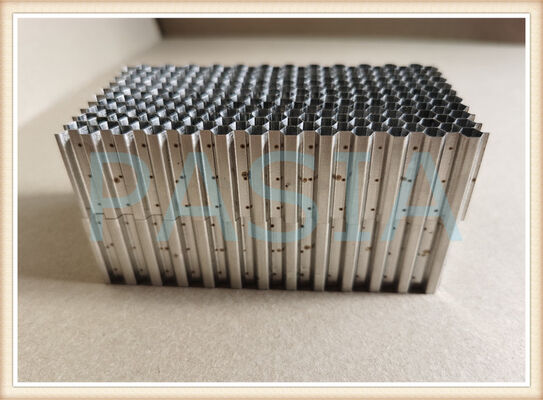
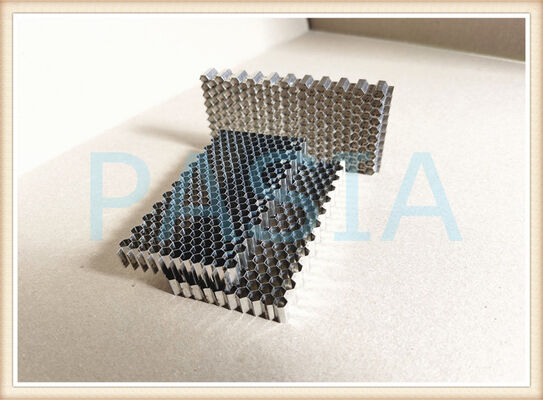
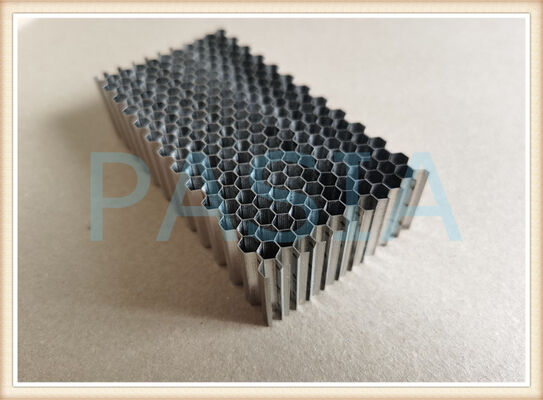
| Material: | Stainless Steel | Bonding: | Spot Welding Or Laser |
|---|---|---|---|
| Material Thickness: | 0.05 | Cell Side Length: | 3 |
| Height: | 3-250 Mm | Applications: | Filtering, Sealing, Shielding, Separating, Guiding And Platform |
| Grade: | SS304,SS316L |
Low Turbulence Stainless Steel Honeycomb Air Flow Straightener 80 to 180 Pa Pressure Drop
This low-turbulence honeycomb air flow straightener is designed to convert swirling, non-uniform airflow into a stable and highly uniform stream with minimal energy loss. With an operating pressure drop range of 80 to 180 Pa, it is suitable for applications where both flow quality and fan energy efficiency are critical. The honeycomb cell structure suppresses lateral turbulence and reduces swirl, helping improve measurement repeatability, sensor accuracy, and downstream airflow distribution.
Key Features
· Low-turbulence flow conditioning: Honeycomb geometry reduces lateral velocity fluctuations and swirl before test sections, sensors, or downstream equipment.
· Optimized pressure drop: Typically operates within 80–180 Pa, depending on cell size, core thickness, open area, and face velocity.
· High open-area design: Maintains airflow with low resistance while improving flow uniformity.
· Rigid honeycomb core: Available in aluminum, stainless steel, or polycarbonate constructions for different temperature, corrosion, and weight requirements.
· Custom geometry: Cell size, thickness, diameter, frame, and mounting options can be customized for duct, wind tunnel, fan-test, and HVAC integration.
Typical Specifications
· Pressure drop range: 80–180 Pa (application-dependent)
· Cell shape: hexagonal honeycomb
· Materials: aluminum, stainless steel, polycarbonate, or customized
· Open area: up to approximately 95%–99%
· Optional frames: aluminum, steel, or custom flanges
· Certification options: RoHS / ISO9001 supplier documentation available
Typical Applications
Wind tunnel settling chambers, fan and blower testing, airflow measurement sections, HVAC duct conditioning, cleanroom air distribution, laboratory benches, and industrial airflow systems requiring low turbulence and predictable pressure loss.
Specifications
| Cell Size (mm) | 25.0 | 16.0 | 12.7 | 10.0 | 6.4 | 5.6 | 4.8 | 3.2 | 1.6 | 0.8 |
| Height Range (mm) | 50-450 | 50-450 | 50-150 | 50-150 | 5-100 | 5-90 | 5-60 | 5-60 | 3-30 | 3-25 |
| Foil Thickness (mm) | 0.20 | 0.20 | 0.20 | 0.20 | 0.20 | 0.20 | 0.20 | 0.20 | 0.076 | 0.05 |
| Cubic Density (kg/m3) | 165 | 256 | 320 | 403 | 616 | 699 | 806 | 1164 | 909 | 1164 |
| Materials | SS304, SS316 or SS316L | |||||||||
| Welding | Spot Welding with one area five spots or laser welding | |||||||||
| Shapes | Customized shape available not limited to ring, plate, loop etc | |||||||||
Properties
Welded honeycomb core, no matter what material is, such as aluminum, stainless steel, steel, titanium etc, possesses better mechanical properties against regularly produced glued honeycomb core. So it performs significantly better again the common honeycomb bonded by adhesive on strength, modulus, corrosion resistance, dimensional stability etc. However, generally, these critical performance variables should be evaluated: material, airflow and attenuation.
1. Material Composition
Stainless steel grade should be considered according to the real application. Custom materials other than stainless steel are available upon request. Here are the parameters need to be evaluated:
Durability
Material type and grade is the first aspect to be evaluated then plating, discussed in depth later, can improve durability.
Weight
Material, structure and thickness of the material can affect the total part weight.
2. Corrosion resistance
Typically brass and stainless steel should be used in slashing environments. Plating or nonconductive surface coatings can improve corrosion resistance for all honeycomb types.
3. Shielding Performance
Different honeycomb core material offerings have different electrical performance, due to both inherent base material properties as well as the differing manufacturing processes used during honeycomb forming. Therefore, different EMI shielding performance may be realized. Shielding performance for different materials is ranked as brass, aluminum, steel and stainless steel. Plating can improve honeycomb shielding.
Specific attenuation requirements can be met through either plated or unplated alloys. Plating adds cost to the final product vent. Plating process for improving shielding is ranked as nickel, tin, tin-lead and zinc.
4. Airflow & Attenuation
Airflow and attenuation are inversely proportional. Infinitely large honeycomb cells result in infinitely small attenuation (and vice versa). Typically, as a design baseline, airflow performance requirements are calculated to meet thermal performance needs for the assembly that the vent is to be installed onto. Once airflow is determined, attenuation and other requirements can be evaluated. Standard cell sizes for honeycomb are 1/16", 1/8" and 1/4", with 1/8" being most common. Standard thicknesses are 1/4," 1/2" and 1," with 1/4" being most common.
Application
• air, water and gas flow straighteners and filters
• EMI/RF Shielding: scientific instruments, sensitive facilities, and hardening.
• tables for water jets
• light separators
• structural pieces in electronic cabinetry, aircraft, thrust reversers, exhaust nozzles
• aircraft engine honeycomb seals and power generation turbine seals